
Give your relationships a fair go.
Fair Go For Families delivers practical, evidence-aligned learning programs that help students, families, partners and households make invisible work visible, share responsibility, communicate without blame and build fairer systems at home.
Respectful relationships need everyday skills.
Many people can name the problem - mental load, resentment, unfair expectations, constant reminders and conflict about who does what. What is often missing is a practical, non-blaming way to change the pattern. Fair Go turns fairness into learnable behaviours: noticing what needs doing, owning responsibility, setting shared standards, communicating clearly and repairing when things go off track.
It is not about blaming people. It is about giving households a better system.
mental load 〰️ invisible labour 〰️ complete task ownership 〰️ agreed shared standards 〰️ check-ins 〰️ repair 〰️
mental load 〰️ invisible labour 〰️ complete task ownership 〰️ agreed shared standards 〰️ check-ins 〰️ repair 〰️
Why Fair Go?
Aligned with the direction of respectful relationships and family wellbeing work.
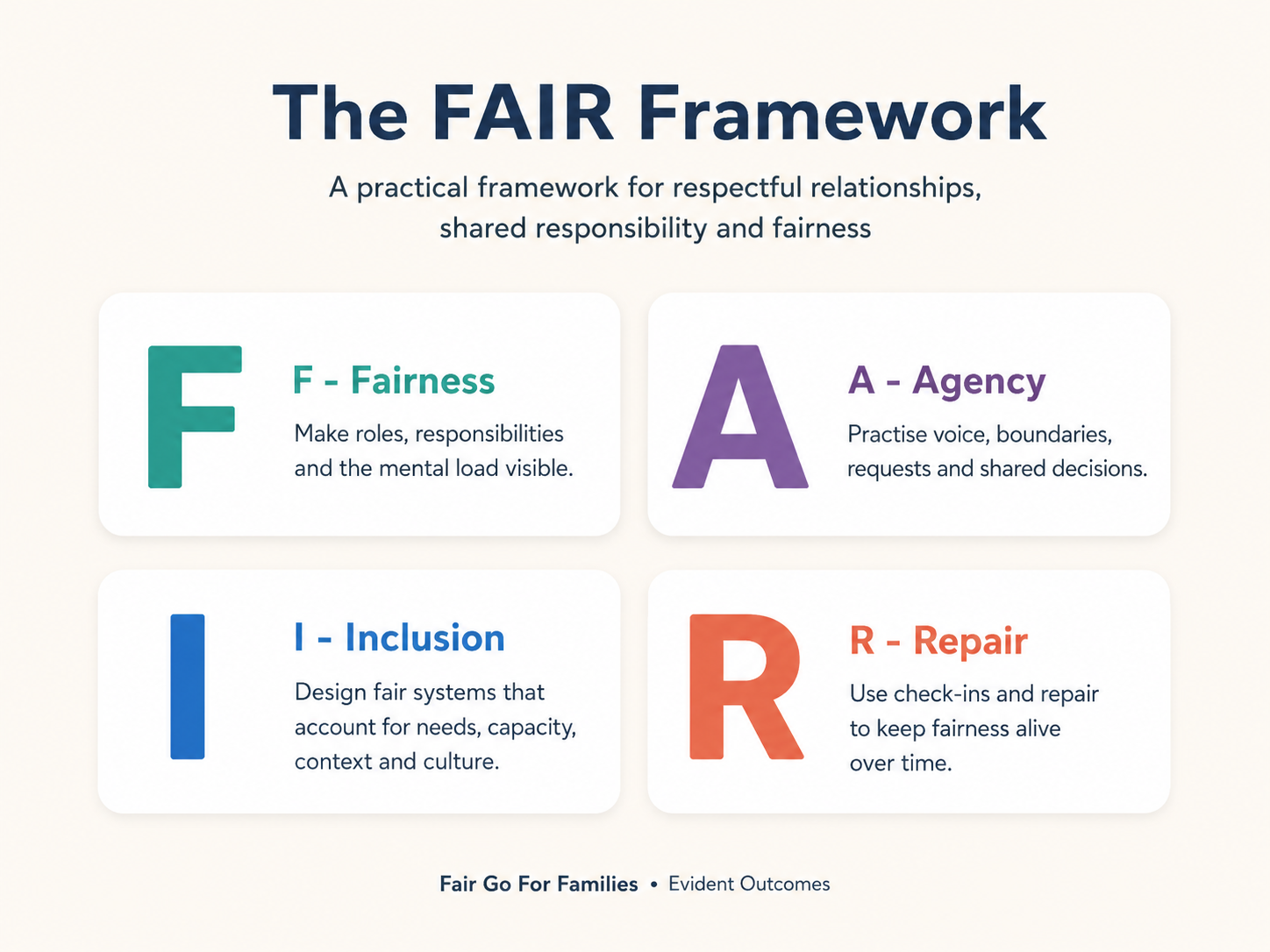
Fair Go supports the national direction towards high-quality, age-appropriate, evidence-based respectful relationships education by making prevention practical. For schools, it provides a skills-based way to explore fairness, equality, voice, boundaries, responsibility and repair. For families and community organisations, it gives people shared language and practical tools for everyday household fairness and wellbeing.
Programs for schools, families and households.
Schools and young people
Practical respectful relationships workshops and pastoral-care modules for students. Students practise communication, boundaries, fair contribution, group-work responsibility and repair through role-play and real-life scenarios.
Families with children
Programs for parents and carers who want to reduce reminders, make invisible work visible, support age-appropriate contribution and build calmer household systems.
Families with teens
Programs that help teens practise adult-ready habits: noticing work, owning tasks, respecting other people's time, communicating without escalation and repairing conflict.
Couples, partners and housemates
Inclusive programs for partners of any gender or family structure who want a practical way to talk about mental load, responsibility and shared standards without getting stuck in blame.
Practical sessions for shared homes where people need clear agreements, shared standards, communication tools and a fair system that does not assume family or couple roles.
What participants do in the sessions
Fair Go is deliberately activity-first, not slide-heavy. Participants practise real conversations and build real agreements in a way that is safe and within their comfort levels.
Activities include: invisible work mapping; responsibility card sorts; role-play conversations; owning the whole task planning; standards agreements; check-in rehearsals; repair scripts; household standards mapping; and between-session Fair Go tasks.
Delivery Options

We work with partner organisations to cater directly to clients’ needs. Some delivery options look like:
One-off workshop: 60-120 minutes for schools, parents, staff teams, community groups or households.
Three-session starter series: a practical introduction to mental load, communication and shared systems.
Six-session course: the full Fair Go learning journey with homework tasks, reflection and implementation support.
Staff professional learning: for teachers, youth workers, family support workers and community practitioners.
Pilot package: intake survey, tailored delivery, outtake survey, short outcomes summary and recommendations for scale-up.
Designed for measurable behaviour change.
We alway begin with outcomes in mind. We want to be sure that we’re creating real change, having a lasting impact.
Fair Go uses simple evaluation tools before and after delivery to capture changes in knowledge, confidence and intended behaviour. Depending on the setting, this can include participant surveys, student reflection tasks, facilitator observations, parent/carer feedback and an optional 30-day pulse check.
Outcomes can include:
increased understanding of mental load and invisible labour;
stronger confidence in respectful communication;
clearer shared standards;
improved willingness to own tasks;
increased use of check-ins, boundaries and repair language.

FAQs and Common Questions
Is Fair Go therapy?
1
No. Fair Go is an education and early-intervention program. It teaches practical tools and shared language. It does not replace counselling, mediation, family violence support or clinical services.
Can schools use it as part of respectful relationships or wellbeing work?
2
Yes. The school-facing offer is designed for wellbeing, pastoral care, respectful relationships, student leadership and parent/carer engagement contexts. Schools can start with a one-off workshop or a small pilot.
What makes it practical?
3
Participants do not just listen to content. They map responsibilities, practise check-ins, rehearse difficult conversations, set minimum standards and complete between-session tasks. This leads to real learning.
Does the couples program assume heterosexual roles?
4
No. The language is inclusive of all partners and family structures. The program focuses on responsibility, expectations, capacity, standards and communication rather than gendered or family structure assumptions.
Can Community Organisations host it?
5
Yes. It can be delivered as a parent/carer group, youth program, community wellbeing workshop, practitioner professional learning or pilot add-on to existing family support services.